A river should unite us
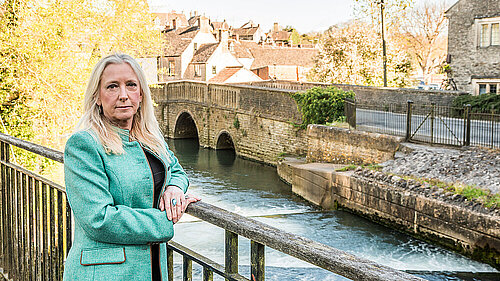
In theory, I could row from my constituency all the way to the House of Commons, following the Thames from its source in the South Cotswolds until it flows past Parliament. It would be a journey through the history of my life; I learnt to row on the Isis in Oxford, and raced in all the usual regattas - Wallingford, Reading, Henley, Marlow, Staines, Molesey, Kingston, and of course the Tideway. I’ve lived alongside the river in Putney, Kew, Richmond, and Windsor, and now I represent the constituency where the Thames rises, and work in the Palace of Westminster.
So, the state of the Thames isn’t just an abstract environmental issue for me - it’s deeply personal - making the river’s daily disrespect and degradation all the harder to stomach.
The latest Environment Agency assessment found that every surface water body in England failed to achieve good chemical status. Some of the pollutants involved are so persistent that, even if we stopped adding to them today, our rivers would not reach good chemical status until 2063 at the earliest. And, of course, we haven’t stopped adding to them.
From the moment the Thames emerges, just outside Coates in Gloucestershire, it begins picking up the consequences of human activity. There is abstraction and agricultural run-off around its upper reaches. Further downstream come sewage discharges, road pollution and ageing treatment works. By the time it reaches London, the cumulative impact of millions of individual decisions has become a much larger problem.
A river is a living system. When a river is sick, that tells us something about the health of the whole landscape around it: the soil, the wildlife, the water we drink and the communities through which it flows.
I see these consequences in my constituency. At Fairford, the River Coln saw a continuous sewage discharge lasting more than 1,070 hours. Across the South Cotswolds, people are understandably furious that waterways they love have effectively been turned into extensions of the sewerage system.
I have repeatedly challenged Thames Water and the Government about this. In Parliament, I have pushed for sewage discharges to be measured by volume and concentration, rather than simply duration. An hour-long discharge might be a trickle or a torrent but currently, the two are reported the same.
And the numbers we do have are staggering. Between 2020 and 2023, more than 72 billion litres of untreated sewage were discharged into the Thames and its tributaries. Mogden sewage works near Twickenham alone released 17.1 billion litres.
If this were simply an engineering problem, it would be difficult enough. But it isn’t. It is also a crisis of ownership, finance and governance. Thames Water is carrying almost £19 billion of debt while its customers have watched executives receive large bonuses and pay rises. Its creditors, including major hedge funds, have spent much of the past year negotiating a rescue deal with Ofwat.
In February, I joined more than 20 MPs in warning that the proposed restructuring risked locking in many more years of pollution. By July, 112 MPs from across the political spectrum were calling for Thames Water to be placed into special administration. That cross-party coalition matters, because the river does not care which colour rosette an MP wears. Nor does sewage stop at constituency boundaries.
That is why I believe we now need an All-Party Parliamentary Group for the Thames, bringing together MPs whose constituencies lie along the whole length of the river, and treating it as what it actually is: one interconnected system.
Perhaps we need new forms of guardianship where individuals and communities observe, report, and advocate for the health of the river, rather than a fragmented bunch of water companies, regulators, government departments, local authorities and different parliamentary committees. This would be a fundamentally Lib Dem policy; focusing on devolving power down to local levels, and empowering communities and volunteers.
Currently, the national response is fragmented and piecemeal; respond to one sewage spill here, one flooding incident there, one financial crisis somewhere else. We keep treating the symptoms while failing to look after the patient. A Thames APPG could bring together MPs, communities, scientists, farmers, businesses, environmental organisations, regulators and water companies to take a more holistic approach and, most importantly, to ask a bigger question: what, and who, would it actually take for the Thames to be healthy again?
I don’t think our ambition should be limited to making our rivers slightly less polluted. We should be aiming for rivers that are alive. Rivers people can swim in without worrying about becoming ill. Rivers full of fish, insects and plants. Rivers that help absorb floods and withstand drought. Rivers that communities once again feel belong to them.
The Thames has connected communities across southern England since time immemorial. Perhaps it can connect their MPs too.
At a moment when Thames Water’s financial model is close to breaking point, this is an opportunity to do more than simply plaster over the problem. We should ask what kind of system we actually want to replace it with, and whose interests that system should serve - including the rights of the river itself.
The Thames flows past Parliament every day. It is about time Parliament started listening to it.
Dr Roz Savage MP
Member of Parliament for South Cotswolds