The Science Is Settled. The Future Is Not.
First published in Challenge Magazine's Autumn 2026 edition for the Liberal Democrat Conference in Brighton, written by Councillor Steve Mason from North Yorkshire Lib Dems.
People keep telling you the “jury is still out” on climate change. That line buys time. Time for delay, but the science is certain.
It is settled.
The Intergovernmental Panel on Climate Change (IPCC), the United Nations body that assesses the science of climate change, states: ‘It’s unequivocal that human influence has warmed the atmosphere, ocean and land.’ Scientific agreement exceeds 99.6%, indicating an exceptionally strong consensus on human-caused climate change. Climate impacts are no longer a question of if, but of when, and how severe they will be; how severe it becomes is still our choice.
If the evidence is this clear, why does public hesitation persist? The answer is not simply that people fail to understand the science. Uncertainty has been manufactured and used to delay. Climate researchers have uncovered a playbook of climate delay: a tried-and-tested strategy that uses strategic vagueness to dilute urgency, blur responsibility and create ambiguity on a grand scale. The gap between scientific certainty and public confidence can therefore persist even when the scientific evidence is strong.
The language of delay often relies on vagueness. Rather than denying climate change outright, it can frame the problem as uncertain, distant or manageable while shifting attention towards the choices of individual consumers.
Take your own carbon footprint, pushed into the mainstream by BP through a major advertising campaign. The message was seductive: ‘This is on you. Fix your lifestyle. Buy the right things, it’ll be OK.’
Of course, our personal choices matter, and we should all play a part. But framing climate action as a test of individual virtue ignores how strongly our choices are constrained by systems we did not build and have little control over. Climate action is then reduced to personal purity: fall short, and we are made to feel guilty; fail, and catastrophe is presented as our personal responsibility. That burden can drive people away from the issue. We are told to count our footprints while the industry counts its profits.
But the polluters have not had it all their way. The UK courts pushed back; the Finch case ruling that carbon pollution from burning fossil fuels cannot simply be ignored refocused attention on carbon-polluting companies. Our collective role now is to make responsibility visible across policymakers, political parties, and companies, and to reframe misplaced climate guilt so anxiety and worry can turn into motivation for change.
How, then, do we empower residents rather than leave them anxious, powerless or disengaged? Lasting policy change requires democratic legitimacy, and legitimacy depends on making that responsibility visible. By showing where responsibility lies and explaining the science in plain language, we can move people from isolated concern towards collective action.
As Sir David Attenborough put it: “Saving our planet is now a communications challenge. We know what to do; we just need the will.”
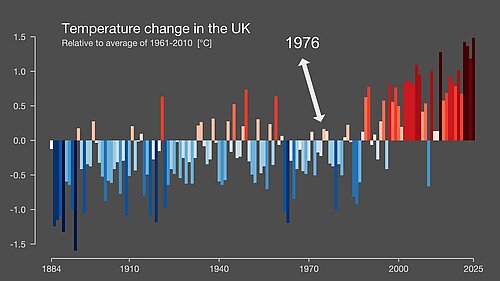
Hawkins’ ‘warming stripes’ show the science plainly and perfectly. No jargon. No debate. Just a sweep from cool blues to burning reds, showing how quickly the world is heating. After a summer of heatwaves and extreme temperatures, their message is hard to ignore: the planet is heating, and the science is certain.
The warming stripes can open a conversation. Acceptance is the first hurdle; the next task is to tell the story clearly and offer credible hope that, by acting together, we can protect people and the planet.
The language we use is crucial. Stark warnings matter because they capture attention, but repeated doom messaging can also push people away, including those who are already concerned. Fear without agency leaves people anxious, blamed, or overwhelmed, and if climate action is heard as partisan rather than as protection of people’s homes, livelihoods, and place, the issue can be siloed within a wider political narrative instead of becoming something for everyone. People don't always reject the issue; often, they cannot identify with the messenger, the tone, or the framing.
The message, therefore, needs to shift from high moral instruction to shared stewardship of the place we live. Prosperity, security, fairness and community make climate action easier to understand as protection of the foundations on which everyday life depends. Our task is to uncouple climate action from narrow partisan perceptions and reconnect it to the communities, homes, livelihoods, services and nature that people value.
Climate communication depends not only on facts, but on how they are presented and by whom. Trusted messengers who can translate risk, help absolve misappropriated guilt, and channel anxiety into shared values, local relevance and collective action can build the mandate for change.
The science is settled, but the future is not. The question for us as a community is how we can respond together in ways that protect the people, places and livelihoods we value.